
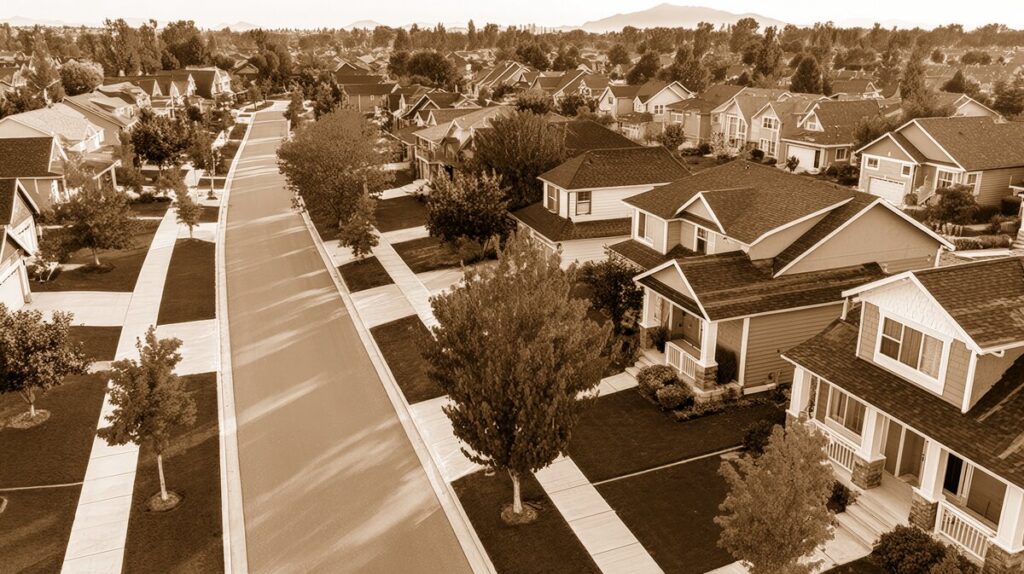
A Newer Neighborhood with an Older Story
Vintage Glen is one of those Westlake neighborhoods that feels contemporary at first glance but becomes more interesting the longer you know it. Located east of Crocker Road between Detroit Road and Hilliard Boulevard, the community is best known today for its attached condominium and townhouse residences, quiet courts, landscaped common areas, and convenient access to shopping, recreation, and major roads.
Most public property records place the construction of Vintage Glen in the mid-to-late 1990s, with many homes dating from approximately 1996 through 1998. The neighborhood was developed during a period when Westlake was changing quickly from a largely rural suburb into a mature, fully built-out Cleveland-area community. Its homes represent that transition: they offer the low-maintenance lifestyle of modern suburban development while standing on land shaped by nearly two centuries of local history.
The name *Vintage Glen* appears to be a neighborhood-era name rather than one connected to a single pioneer family or historic event. “Vintage” suggests a connection to Westlake’s older character, while “Glen” evokes the wooded, gently landscaped setting found throughout this part of the city. Although a formal explanation of the name is not widely documented, it fits a community built to reflect comfort, greenery, and a sense of established place.
From Dover Township to Westlake
To understand Vintage Glen, it helps to look beyond its boundaries. Westlake began as part of Dover Township, a community settled by New England families in the early 19th century. Among the earliest settlers were Joseph and Lydia Cahoon and Asahel and Rebecca Porter, who arrived in 1810. Other pioneer families included the Johnsons, Crockers, Halls, Smiths, and Westons. Their names remain visible on today’s street signs, cemeteries, institutions, and historic properties.
The area around present-day Crocker Road and Center Ridge Road became an early center of activity. Farms, mills, small industries, churches, and family homesteads gradually developed across the township. Dover’s agricultural history was especially notable for grain, small fruit, and grapes. In the late 19th century, the township became one of the country’s important grape-shipping areas, helped by the arrival of the Nickel Plate Railroad in 1881.
That rural heritage is easy to overlook when driving past today’s shopping centers and residential developments. Yet the broad roads and large parcels of Westlake still hint at the farming landscape that came before them. Vintage Glen belongs to that later chapter of development, but its setting is part of the same continuous story.
The Road to Modern Westlake
Dover Village was incorporated in 1911. In 1940, the community adopted the name Westlake to avoid confusion with Dover in Tuscarawas County. The village later became a city in 1957.
For much of the first half of the 20th century, Westlake remained a quiet place of farms, truck gardens, flower gardens, and scattered homes. The postwar decades brought new subdivisions, schools, businesses, and public services. Interstate 90, completed through the area in 1976, made Westlake more accessible to Cleveland and helped accelerate residential and commercial growth. The city’s population expanded from 15,989 in 1970 to 19,483 in 1980 and 27,018 in 1990.
Vintage Glen emerged during the next phase of that growth. By the 1990s, Westlake was no longer simply a rural-edge suburb. It had become a desirable city with established neighborhoods, strong civic services, office parks, medical facilities, and recreational amenities. The development of Vintage Glen reflected the era’s growing demand for clustered housing that offered attractive architecture, attached garages, private courtyards, and less exterior maintenance than a traditional detached home.
Streets and Places That Define the Neighborhood
Vintage Glen’s internal streets include Piedmont Court, Woodruff Court, and Buckthorn Place. These short residential courts give the community a more intimate feel than a conventional subdivision built around long through-streets. The layout encourages a slower pace, with homes facing one another across landscaped areas rather than busy traffic corridors.
The neighborhood’s location is one of its greatest strengths. Residents are close to Crocker Road, one of Westlake’s principal commercial and transportation routes, as well as Detroit Road and Hilliard Boulevard. Crocker Park, with its shops, restaurants, offices, and public gathering spaces, is nearby. The Westlake Recreation Center and its surrounding parkland are also close enough to become part of everyday life, whether for fitness, swimming, classes, walking, or community programs.
The city’s parks add another layer to the story. Clague Park, named for the pioneering Clague family, preserves one of Westlake’s important historic landscapes. The Clague House, maintained as a museum by the Westlake Historical Society, helps residents picture the city before subdivisions and commercial corridors transformed the countryside.
Heritage Sites Nearby
Vintage Glen itself is a late-20th-century residential community, so its historical significance is found less in landmark buildings within the neighborhood and more in the surrounding landscape.
Several historic homes and sites elsewhere in Westlake help connect present-day residents to the city’s beginnings. The Weston House at 27946 Center Ridge Road, near the Westlake Recreation Center, dates to the 19th century and is associated with the Weston family. The Hall House, built around 1834 at Westwood and Columbia roads, is another surviving example of early local architecture. Other historic homes associated with the Smith, Crocker, and Cooley families remain important reminders of the area’s pioneer period.
Evergreen Cemetery, near Porter and Center Ridge roads, is also significant. Early settler Leverett Johnson donated land for the cemetery, where he and members of other pioneer families are buried. Maple Ridge Cemetery on Columbia Road began as a Hall family cemetery, and even Columbia Road once carried the name Hall Road.
These places give Vintage Glen residents something valuable: a sense that their homes are not isolated from history but are part of a community layered over generations.
How Vintage Glen Has Evolved
Since its creation, Vintage Glen has matured from a new townhouse and condominium development into an established neighborhood. Landscaping has filled in, trees have grown taller, and many residences have been updated with renovated kitchens, refreshed flooring, new lighting, and modernized bathrooms. The community’s original design remains recognizable, but the appearance has softened with age.
The neighborhood has also benefited from Westlake’s broader evolution. Nearby Crocker Park has become a regional destination, the recreation center has expanded its role as a civic gathering place, and the city has continued investing in parks, roads, public safety, and community services. The result is a neighborhood that offers both convenience and continuity.
What makes Vintage Glen special is not the presence of a single famous monument. It is the way everyday life connects to Westlake’s larger heritage. A walk along Piedmont Court or Woodruff Court may pass homes built in the 1990s, but beyond them are roads named for pioneer families, parks shaped by old estates, cemeteries holding early settlers, and a city whose identity has changed repeatedly while remaining rooted in place.
Vintage Glen’s story is therefore a modern one with historic foundations. It represents Westlake’s move from farms and grape fields to connected neighborhoods and amenity-rich suburban living—while still carrying, in its surroundings and spirit, the enduring character of old Dover Township.